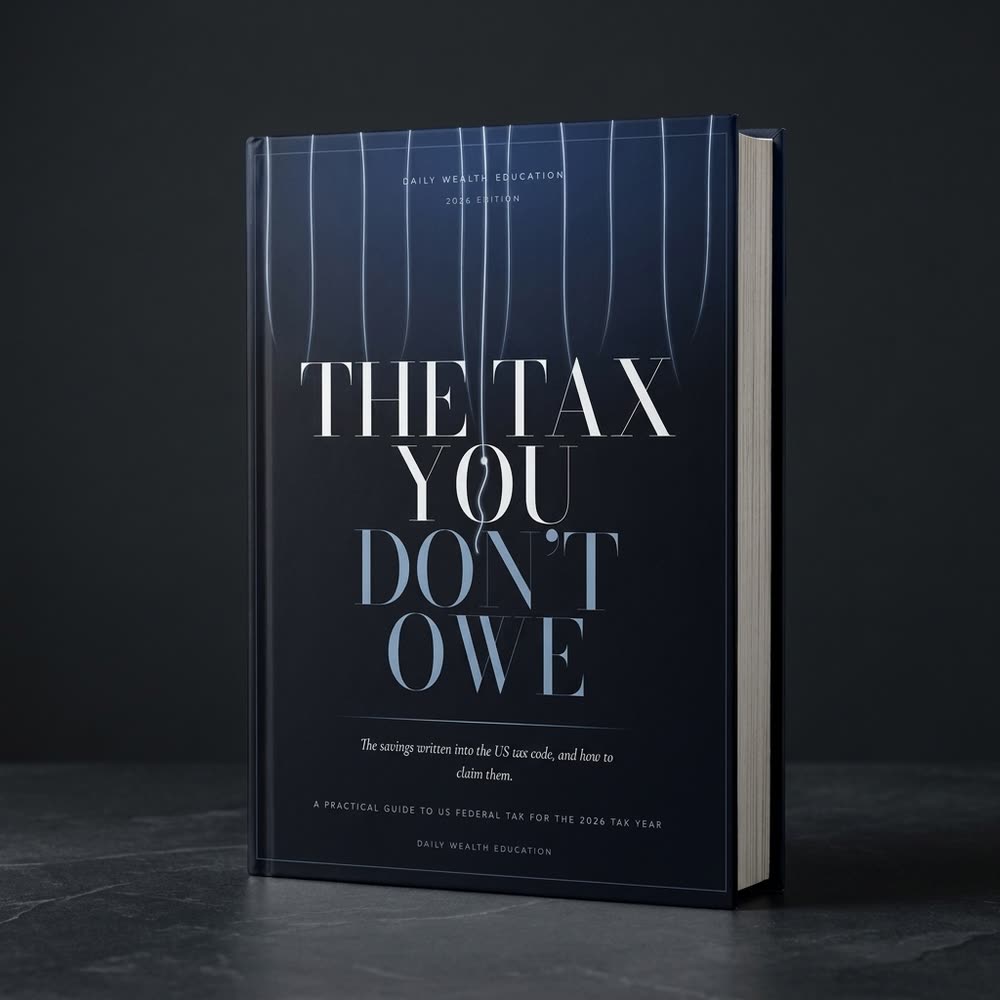
The Tax You Don’t Owe
A real printed book, made to be written in. The worksheets are the reason this edition exists — a tax book you can leave open on the desk in December.
What you get
Properly bound, posted to your address. This is the physical edition — nothing digital is included.
Sixteen worksheets with room to write, and margins wide enough to argue with.
Printing and binding takes a few working days. You get a tracking number by email the moment it ships.
It posts to the address you enter at checkout — worth reading twice before you pay.
What the book does
Two people earn $95,000 at similar jobs in the same city. One of them contributes to a workplace plan and a health savings account through payroll; the other does nothing in particular. In a single year they are $6,655 apart. Over twenty years, one holds $1,184,770 the other does not, and has paid $133,092 less in federal tax.
Neither worked harder. Neither took more risk. One of them filled in a form.
The Tax You Don’t Owe is the explanation of that gap, in the order it actually matters: what you are paying now, which of your two tax rates prices a decision, the three legal things you can do to a dollar, the four accounts that do the work, the order to fund them in, and the thresholds that charge you a whole year’s money for a single dollar of income.
Written for the 2026 tax year. Figures come from primary sources — the IRS, the Social Security Administration and CMS — not from other published guides, several of which are out of date after the legislation enacted in 2025.
Inside every chapter
Real arithmetic with named figures, carried all the way through. Not “you could save thousands” — $6,318, and here is each line of it.
The beliefs that cost people money: that a raise into a higher bracket leaves you worse off, that overtime is taxed differently, that your accountant is planning for you.
One per chapter. Your true marginal rate, your account inventory, your funding order, your threshold map, your transfer audit.
The four or five moves that follow from each chapter, stated as instructions rather than theory.
Seven lines at the end of every chapter, so you can find the one figure you half-remember.
A single task at the close of each chapter — usually ten to twenty minutes, usually today.
Questions
Is this tax advice?
No. It is educational. It explains how the federal system works and where the law provides room to pay less, but it does not know your circumstances and cannot replace a qualified professional who does.
Which tax year does it cover?
The 2026 tax year, United States federal tax. Every figure was taken from primary sources — the IRS, the Social Security Administration and CMS — at the time of writing.
Is it only for high earners?
No. The opening example is two people on $95,000 who end twenty years apart. Most of the book is about ordinary salaried households, with later parts for the self-employed and for people approaching retirement.
Does it cover state tax?
Not in detail. Rates and rules vary so much between states that any specific figure would be wrong for most readers. Where state tax changes the answer, the book says so.
What if I am not in the United States?
This book is US federal tax only. If you file elsewhere, it will be interesting rather than useful.
Can I get a refund?
Yes — if something is wrong with your order, reply to the confirmation email and it gets sorted.